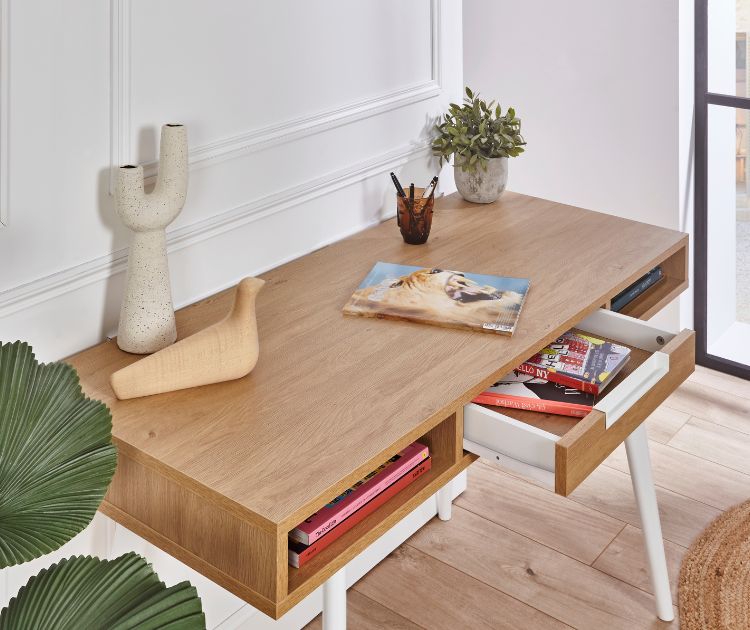
Did you know that your muscle tension is often related to an incorrect adult desk height? Precise adjustment of your workstation is enough to guarantee healthy ergonomics and relieve your back. Here you'll find the exact height and practical advice to adjust your furniture to your body type.
The ideal desk height: key figures and simple calculation
Standard heights to know
The standard height generally ranges between 28 and 29.5 inches. While it suits the majority, this measurement is not universal and may harm the comfort of certain body types.
Up to 5'5", we strongly recommend 23.6 to 25.6 inches.
Between 5'5" and 5'9", the standard of 25.6 to 29.1 inches is most common.
For 5'9" and above, aim for 29.5 to 35.4 inches.
These standards are a foundation, but fine-tuning will always depend on your body type.
Calculate your personalized height in a flash
For surgical precision, apply this formula from the NF EN ISO 9241-5 standard: Desk height (inches) = (Your height in inches × 0.40) – 0.4.
For example, if you are 5'7" (67 inches), the calculation is: (67 x 0.40) - 0.4 = 26.4 inches. A much more personalized starting point.
Height / desk height correspondence chart
To quickly visualize the recommendations, a chart remains the ideal tool. Here is the recommended adult desk height according to your height.
Your height
Recommended desk height
5'3"
24.8 in
5'5"
25.6 in
5'7"
26.4 in
5'9"
27.2 in
5'11"
28 in
6'3"
29.5 in
These measurements are recommendations based on the formula. Your body type (leg/torso length) may require adjustment.
These tools are excellent for getting started. But beware, adult desk height alone isn't enough; overall posture remains crucial.
Moreover, this calculation is of course different from the one used to determine the desk height for a child.
Beyond height: posture, the true key to your comfort
The famous 90-degree rule explained
A precise measurement in centimeters isn't enough if your overall posture is lacking. Everything relies on an infallible visual reference for your body. It's the golden rule of 90 degrees.
This ergonomic standard precisely targets two critical angles of your anatomy once seated facing the desktop. It guarantees a natural alignment, without any unnecessary tension.
Here are the exact benchmarks to monitor to immediately validate your setup:
The elbows: They should form a right angle when your forearms rest flat on the desk, shoulders down.
The knees: They should also be bent at 90°, with your feet flat on the floor.
The risks of incorrect height: more than just pain
Ignoring these adjustments is costly for your long-term physical health. A desktop that's too low forces you to dangerously curve your spine. Too high, it makes your shoulders rise. It's an open door to musculoskeletal disorders (MSDs).
The damage accumulates insidiously: neck stiffness, persistent tension in the back and lower back, wrist fatigue. These chronic pains settle in often without warning.
Let's not forget eye strain and severe headaches. Everything is connected.
The role of your office chair
Your desk and your chair form an inseparable duo for your daily well-being. The height of the work surface cannot be correct without a properly adjusted chair. Never neglect this technical pair.
Always start by adjusting your seat: feet flat, knees at right angles. It's only afterward that you adjust the desk height to align your elbows at 90°. The reverse order skews the entire ergonomic assessment.
The chair first adapts to your body. The desk then adapts to your seated posture.
Is your desk not the right height? solutions to adjust it
Theory is ideal, but what do you do when your current desk doesn't fit? Ignoring these adjustments means risking paying the price with your back. Here are concrete solutions to adapt existing furniture.
Adapting a fixed desk: the tricks that make all the difference
Don't worry, no need to change everything. Simple solutions exist to correct the height of a fixed desk. If your desk is too high, which is common, the solution comes from adjusting the seat and feet.
If the desk is too high: Raise your chair to achieve a 90° angle at the elbows, and use a footrest to keep your legs from dangling.
If the desk is too low: The most reliable method is to place risers or solid blocks under each desk leg.
The height-adjustable desk option
Height-adjustable desks are emerging as the most flexible solution. Their advantage is to adapt perfectly to any body type and chair. Additionally, they allow you to alternate between sitting and standing positions.
Changing positions throughout the day is excellent for combating sedentary lifestyle and stimulating blood circulation. It's an effective way to stay dynamic.
Don't neglect the height of your screen
It's the blind spot of ergonomics: screen height. A properly adjusted desk is useless if you have to lower your head. The top of the screen should be at eye level, or slightly below.
This golden rule keeps your neck straight and helps avoid neck pain. Use adjustable stands or a simple stack of books to correct the level.
Choosing the right desk: dimensions and integration into your space
If adjustment isn't possible or if starting from scratch, you need to know what else to look for besides height to avoid regretting your purchase.
Desktop depth and length: the space you need
Focusing solely on height would be a costly mistake for your daily comfort. A desktop that's too small inevitably causes constant clutter and forces the body to adopt poor posture.
To work effectively without feeling cramped, here are the standard dimensions validated by ergonomics experts.
Desktop depth: Aim for between 23.6 and 31.5 inches to have enough distance from the screen.
Desktop length: A minimum of 47.2 inches is recommended to be able to place a computer, documents, and have space to move.
Consider the space for your legs
It's the detail that 90% of people neglect until they bump their knees. The space under the desk must be sufficient to extend your legs and change position without hitting the structure. Fixed cabinets quickly become annoying obstacles.
Take out your measuring tape before making a decision. Check the available height between the floor and the underside of the desktop (or drawer). A clear space of at least 24-25.6 inches.
Incorporating a desk into a bedroom: space-saving solutions
Setting up a work area in an adult or teen bedroom requires ingenuity. Space optimization becomes the absolute priority to avoid suffocating the room with bulky furniture. Clever solutions exist to combine sleep and productivity.
To successfully achieve this setup, it's useful to know how to properly choose your bedroom desk.
Finding the ideal desk height is essential to preserve your health and daily comfort. Don't forget that overall posture remains the key: adjust your chair, your screen, and enjoy an ergonomic and serene work environment.
 En
En
 Français
 Deutsch
 Nederlands
 Italiano
 Español













 What Age for Bunk Bed: Standards and Safety
 When to put baby in their room: age and transition
 Best Choice for Baby: Bed Attached to Parents or Next to Them?
 The convertible bed: furniture that grows with your child
 The bunk bed with storage and desk: discover its advantages!