Are you hesitating about which bed size to choose to combine comfort and space layout? Choosing between a single, double, queen size or king size model is essential to ensure quality sleep. That's why this guide will help you determine the dimensions suited to your bedroom and mattress, taking into account your habits and available space.
Understanding standard bed dimensions
Basic sizes for one person
For an adult sleeping alone, standard single bed widths are around 90 cm, with lengths from 190 to 200 cm. Some people prefer a 120 cm wide bed, especially if a child occasionally shares the sleeping space. The designer and eco-designed single bed is often a smart choice. The ideal size? Yours + 20 cm, to move freely. Note that Scandinavian bed bases sometimes reach 90x210 cm, perfect for tall people.
French standard: 90x200 cm
United Kingdom: often 90x190 cm (beware of duvets that are too short)
Nordic countries: up to 90x210 cm for comfortable sleeping
Common double bed dimensions
Bed type
Dimensions (cm)
Dimensions (inches)
Queen Size (Europe)
160x200 cm
63x79 inches
Queen Size (USA)
152x203 cm
60x80 inches
King Size (Europe)
180x200 cm
71x79 inches
King Size (USA)
193x203 cm
76x80 inches
The 160x200 cm (Queen Size) has become the current standard for couples. 140 cm wide beds remain popular in small children's bedrooms. This practical guide shows that optimal sleeping depends as much on the mattress as on the chosen bed base.
Our various Chambrekids guides on bed dimensions
For more information on bed dimensions, Chambrekids offers its various guides:
This guide details baby bed sizes according to growth stages: the cradle (40x90 cm) for the first months, the crib (60x120 cm) until age 3, and the transition bed (70x140 cm) until age 5.It emphasizes safety and comfort, recommending dimensions suited to each age.Advice is provided on when to move to a larger size, particularly when the child starts climbing the bars.The article helps parents make informed choices for their child's sleep.
This article presents the different single bed sizes, ranging from 70x140 cm for young children to 120x190 cm for adults seeking more space.It explains the specific uses of each dimension, according to the sleeper's age and body type.Practical advice is given for choosing the size suited to the bedroom and comfort needs.The article emphasizes the importance of a good choice for quality sleep.
Choosing the right size for your needs
Calculating available space in the bedroom
To properly choose your bed dimensions, start by measuring your bedroom. Allow for a circulation margin of at least 50 to 60 cm around the bed base to avoid accidents. Note that a bed placed near a window will require special attention regarding the opening of the shutters.
In a 10m² bedroom, a standard double bed (140x190 cm) is a wise choice. This choice preserves vital space for circulation, unlike Queen or King sizes which require at least 12m². For spacious rooms (15m²), 160x200 cm or 180x200 cm beds offer generous sleeping space, especially when sharing your bed.
Adapting bedding to the number of sleepers
Choosing a bed for couples involves some considerations. Let's look at the key points:
Assess the actual room size. Wide bed bases like King Size require a proportionate bedroom
Consider your body types. A 160x200 cm bed is better suited for larger people or those who like their nighttime space
Analyze your movements during sleep. Mattresses with motion isolation reduce unwanted awakenings
Determine your firmness preferences. Some mattresses even offer differentiated zones to adapt to each sleeper
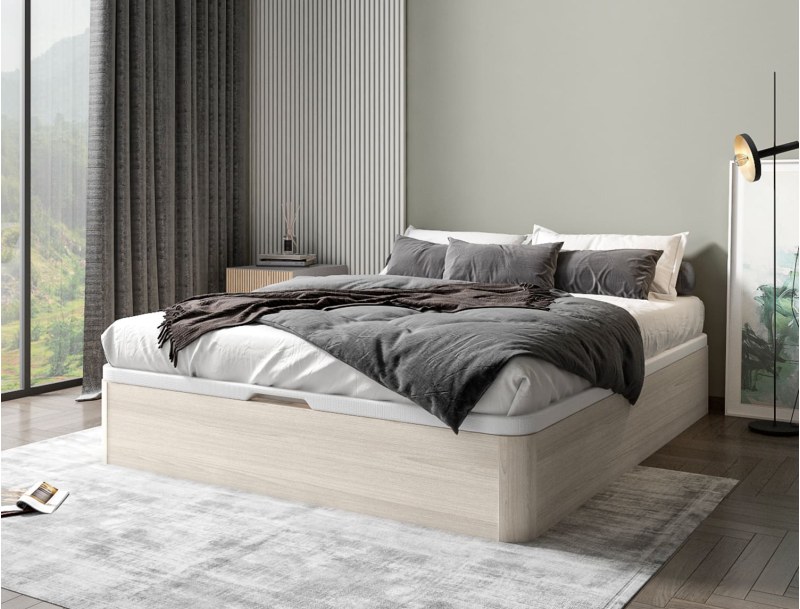
Think about bed access. In small bedrooms, opt for bed bases with storage drawers to save space
This practical guide will help you find the optimal bed. Don't forget to check the corresponding duvet sizes - a duvet that's too small on a large bed base compromises comfort. For children, 90x190 cm beds remain the most suitable standards.
Special cases to consider
Children's and junior bedding
The 90x190 cm children's bed base corresponds to standard sizes to follow children's growth. The transition from the baby bed to this model is crucial for safe sleeping; our guide details the ideal dimensions for a baby bed.
The adjustable bed bases adapted to different children's sizes. Good to know: safety rails must meet precise standards. The distance between the frame and guardrails must not exceed 7.5 cm, while the gap between bars remains less than 7 cm. For an informed choice, consult our analysis: Why choose a 90x190 bed.
Medical beds and other specific types
In the case of medical beds, width plays a key role in facilitating care and movement. It should be noted that current standards do not specify official minimum dimensions.
Custom-made bed bases meet specific needs, but require longer manufacturing times. Paradoxically, this solution allows you to obtain optimal length and width, even though technical information remains limited.
Compatibility between bed and mattress
❌ Common mistakes to avoid
A poor fit of dimensions between the bed base and mattress risks permanently compromising comfort. Note that modifying a mattress is not recommended: it alters its internal structure and support. The sleeping surface size directly influences your freedom of nighttime movement. A longer mattress provides more room to stretch, especially if you share the bed with a child.
To choose well, take care to measure your existing bed base. When assessing, don't forget the edges or borders that reduce usable space. The actual width is calculated between the inner walls of the frame - this measurement determines compatible mattress sizes. If you already own bedding, use it as a reference to select a storage bed base. But beware: some baby models require specific dimensions, different from adult standards.
Still hesitating about the ideal bed size? Know that this choice directly influences your sleep and your space layout. Measure your bedroom carefully, think about your habits - and above all, don't delay in creating this personalized comfort nest. One certainty: your perfect bedding is just waiting for you!
 En
En
 Français
 Deutsch
 Nederlands
 Italiano
 Español













 What Age for Bunk Bed: Standards and Safety
 When to put baby in their room: age and transition
 Best Choice for Baby: Bed Attached to Parents or Next to Them?
 The convertible bed: furniture that grows with your child
 The bunk bed with storage and desk: discover its advantages!