Choosing the ideal dimension for a double bed can quickly become a puzzle given the diversity of formats available on the market. Between French standards, Anglo-Saxon names like king size or queen size, and space constraints in your bedroom, the options seem endless. This article guides you through the different double bed sizes, their specific advantages, and how to select the one that perfectly matches your sleep needs and available space.
Standard dimensions of a double bed
Classic measurements in France and Europe
In France, the standard double bed typically measures 140 cm wide by 190 cm long, which is equivalent to about 55 x 75 inches.
The 140x200 cm double bed is an increasingly popular alternative, offering an extra 10 cm in length for taller people. This dimension is gaining popularity as it improves comfort without taking up much more space.
The 160x200 cm size, recognized as a queen size dimension, offers more space for each sleeper, while the 180x200 cm option (king size) provides maximum comfort for couples.
King size and queen size appellations
The terms king size and queen size, of Anglo-Saxon origin, correspond respectively to beds of 180x200 cm and 160x200 cm in the European metric system.
Bed type
Dimensions (cm)
Sleep independence
Standard double bed
140 x 190
Low
Extended double bed
140 x 200
Low
Queen Size Bed
160 x 200
Average
King Size Bed
180 x 200
High
The king size bed is particularly suitable for couples who appreciate having a large personal space during sleep.
Special and custom dimensions
Beyond standard sizes, you'll also find larger formats like super king size (200x200 cm) or custom dimensions to meet specific needs. These options can be ideal for very tall people or those seeking maximum sleeping space.
Opting for a non-standard bed size, however, involves some practical constraints. The price of a custom-made bed is higher than a standard model due to the required craftsmanship. Additionally, finding suitable bedding (sheets, covers, duvets) becomes more complicated and often more expensive. Adapting standard bedding elements sometimes requires adjustments or purchasing specific products, which increases the overall budget of your bedding.
The width and length of a double bed significantly influence your sleep comfort. Too little space can lead to nighttime disturbances, particularly for couples. The minimum recommended width for comfortable sleep for two is 140 cm, but 160 cm offers superior rest quality by limiting mutual disturbances.
For optimal comfort, the bed length should exceed the height of the tallest person by at least 15 to 20 cm. People measuring over 1.80m should prefer a bed 200 cm long rather than the standard 190 cm. For couples with different sleep habits (one moves a lot, the other is sensitive to movements), a king-size bed 180 cm wide offers the necessary independence for peaceful sleep.
How to choose the right dimensions for your needs
Taking into account the room size
The available space in your room is the first criterion to evaluate before choosing the dimension of your double bed.
Measure your room precisely before any purchase.
Sufficient circulation space around the bed.
Take into account the location of doors and windows.
In a room with reduced surface area, opt for a standard size bed (140x190 cm) to maintain smooth circulation around the bedding.
Leave at least 50 to 60 cm between the bed and furniture.
Multifunctional furniture.
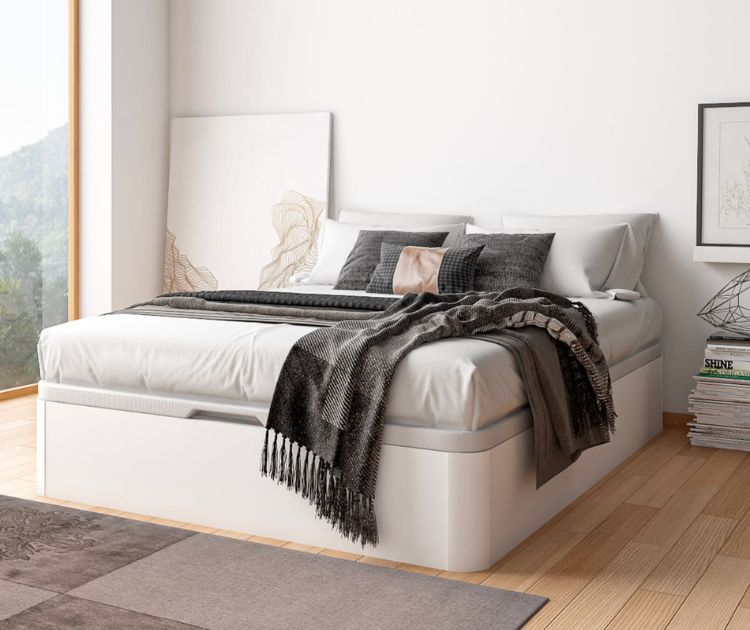
Consider beds with built-in storage for space saving.
Considering comfort and personal preferences
Sleeping habits significantly influence the ideal dimensions for your bed. A sleeper who moves a lot during the night will appreciate more spacious bedding while a tall person will benefit from a longer bed.
The personal space needed for each sleeper varies according to their morphology and nocturnal habits. Generally, 70 cm width per person is recommended for quality sleep.
Couples with different bedtime schedules benefit from choosing a queen size bed (160x200 cm) which limits mutual disturbances. The ideal size also depends on your usual sleeping position, with back sleepers requiring more space than those who sleep in the fetal position.
The consistency of dimensions between the bed, mattress, and bed base significantly influences your daily sleep comfort. Even a slight incompatibility between these elements can lead to premature wear of your bedding.
The gap between the mattress and bed base dimensions should remain minimal to ensure adequate support.
A 140x190 cm mattress placed on a 140x200 cm bed base will leave a 10 cm empty space, creating an unsupported area that can compromise the mattress's durability. For fitted sheets, their size must perfectly match that of the mattress, also taking into account its thickness. A sheet that's too small will easily come off, while a model that's too large will form uncomfortable wrinkles during the night.
To adapt a mattress that's too small to a larger bed frame, some practical solutions exist. You can use pillows or bolsters to fill the empty space and prevent the mattress from sliding. Wooden boards can also reduce the inner size of the frame to better accommodate a small mattress. In some cases, using a mattress topper slightly larger can mask dimensional differences while improving the overall comfort of your bed.
International comparison of double bed dimensions
American vs European standards
Bed dimensions vary considerably from one continent to another, sometimes creating confusion during international purchases.
In Europe, a standard double bed usually measures 140x190 cm, while in the United States, the equivalent "full" or "double" bed is about 135x190 cm. This 5 cm width difference may seem minimal, but it directly affects bedding compatibility. As for queen size beds, the European standard typically offers 160x200 cm, while the American model measures approximately 152x203 cm. The most significant difference concerns king size beds, with 180x200 cm in Europe versus 193x203 cm for the American model.
Bed type
Dimensions (cm) - Europe
Dimensions (cm) - USA (approx.)
Full/Double
140 x 190
135 x 190
Queen Size
160 x 200
152 x 203
King Size
180 x 200
193 x 203
Note: This table presents an approximate comparison of double bed dimensions between Europe and the United States. Please note that these dimensions may vary by manufacturer.
Impact on imported bedding choice
Purchasing an imported bed set can cause fitting issues due to these dimensional differences.
To adapt a mattress to international standards, several solutions exist depending on the observed difference. A mattress topper can compensate for a size difference between a European bed frame and an American mattress.
Stretchy covers represent a practical option to accommodate variations between dimensions. Some specific accessories like frame adapters allow adjusting a bed to non-standard dimensions. To ensure optimal compatibility, it remains preferable to favor products with local standards that guarantee a perfect fit.
Several specialized retailers now offer bedding collections with international dimensions in the French market. These stores cater to a growing demand for products with American standards, especially for people accustomed to these formats during stays abroad.
Adapting double bed dimensions to your living space
Solutions for small bedrooms
Small rooms require adapted solutions to integrate a double bed without sacrificing circulation space. A bed measuring 140x190 cm is often the comfortable minimum for two people in a restricted space. Slightly narrower models also exist for cases where every centimeter counts.
Arranging a small room around a double bed requires careful consideration. Favor placing the bed against a wall to free up circulation space on one side. Choose suspended or narrow bedside tables to maximize available space. Wall lighting rather than traditional bedside lamps also allows you to save precious space. Opt for under-bed storage to compensate for the lack of space.
Space optimization in large bedrooms
In a spacious bedroom, a king size bed measuring 180x200cm offers superior comfort and serves as a focal point that visually structures the sleeping space.
To make the most of a large bed, maintain a harmonious balance with the rest of the furniture. Allow approximately 70 cm of free space around the bed for smooth circulation. Position the bed to create distinct areas in the room if space permits. Choose bedside tables proportioned to the bed size to maintain visual harmony throughout the room.
Space-saving bed options
The trundle bed is an excellent solution for limited spaces, allowing you to free up floor space during the day while providing standard sleeping accommodation for two people at night.
In terms of dimensions, a double trundle bed typically follows standards providing the equivalent of 2 single beds placed together with a 90x200cm bed and a 90x190cm trundle drawer.
This type of bed should ideally be placed against a wall and ensure there is enough space to deploy the second pull-out bed. Some models also include additional storage or a front sofa.
A quality trundle bed is perfectly suited for daily use, with modern mechanisms designed to withstand thousands of opening and closing cycles.
Impact of double bed dimensions on room circulation
The bed dimension directly influences movement fluidity in your bedroom, an aspect often overlooked but essential for daily comfort.
To properly arrange your bedroom, here are some spacing recommendations.
Maintain sufficient space for easy circulation.
Adjust the spacing to your room's configuration.
Consider furniture and door opening.
Easy access on both sides of the bed significantly improves daily comfort. Choose a bed height adapted to your body type, generally between 45 and 55 cm including the mattress. Also consider the location of electrical outlets and switches that must remain accessible once the bed is installed. The bed's positioning relative to doors and windows influences natural circulation in the room.
Beyond practical aspects, the bed size affects the overall atmosphere of the room. A bed that's too imposing can create a feeling of suffocation while a model that's too small risks appearing unbalanced in a large space. Visual harmony contributes to the feeling of well-being essential in this space dedicated to rest.
Choosing the right dimensions for a double bed is important to ensure restful sleep and harmony in your bedroom. Since the bed is the central element of your sleeping space, take time to measure your room and consider your sleeping habits before making a decision. A good balance between available space and personal comfort will transform your bed into a true haven of rest for years to come.
 En
En
 Français
 Deutsch
 Nederlands
 Italiano
 Español













 What Age for Bunk Bed: Standards and Safety
 When to put baby in their room: age and transition
 Best Choice for Baby: Bed Attached to Parents or Next to Them?
 The convertible bed: furniture that grows with your child
 The bunk bed with storage and desk: discover its advantages!